
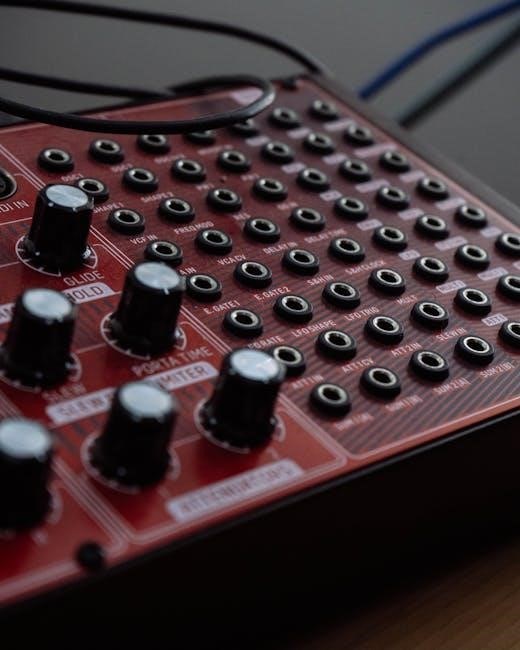
make noise maths manual
Make Noise Maths Manual: A Comprehensive Overview (04/01/2026 04:53:03)
Make Noise Maths is a versatile analog computer for musical exploration. This manual details its diverse functions, from generating LFOs and envelopes to complex signal processing.
It allows for voltage-controlled computations, offering a unique approach to sound design.
Make Noise Maths represents a departure from traditional synthesizer modules, functioning as a dedicated analog computer tailored for musical applications. Unlike oscillators or filters with predefined roles, Maths offers a flexible platform for crafting sounds through voltage-controlled manipulation of mathematical functions. This module isn’t about recreating existing instruments; it’s about building new ones from the ground up.

At its core, Maths excels at generating and shaping control voltages, the lifeblood of modular synthesis. It’s capable of producing a wide array of waveforms – triangles, ramps, and more complex shapes – that can be used to modulate other modules, creating dynamic and evolving sounds. However, its capabilities extend far beyond simple LFOs.
Maths can function as a powerful envelope generator, offering precise control over attack, decay, sustain, and release parameters. It can also be utilized for signal processing tasks like addition, subtraction, portamento, and slew processing. The module’s open-ended design encourages experimentation, allowing users to discover unique and unexpected sonic possibilities. Its versatility is further enhanced by its compatibility with external modules, such as the MMG, unlocking even more complex behaviors.
This manual serves as a guide to unlocking the full potential of Maths, exploring its various functions and demonstrating how they can be combined to create compelling and innovative sounds.
Core Functionality: Analog Computation
Make Noise Maths operates on the principle of analog computation, utilizing voltage levels to represent numerical values and electronic circuits to perform mathematical operations on those values. Unlike digital systems that rely on discrete calculations, Maths performs continuous, analog calculations, resulting in organic and nuanced behavior. This approach is fundamental to its unique sound and flexibility.
The module’s core functionality revolves around manipulating voltage over time. Inputs and outputs represent voltages, and the internal circuitry alters these voltages based on the selected function and control parameters. This allows for the creation of complex waveforms, envelopes, and control signals that would be difficult or impossible to achieve with traditional synthesis techniques.
Maths doesn’t “think” in terms of notes or frequencies; it operates solely on voltages. This abstraction is key to its power. By treating sound as a series of voltage changes, it allows for incredibly precise and expressive control over sonic parameters. The module’s ability to add, subtract, and process voltages opens up a vast landscape of sonic possibilities, making it a cornerstone of many modular synthesizer setups.
Essentially, Maths is a building block for creating custom synthesis voices and control systems, limited only by the user’s imagination and understanding of analog circuitry.
Understanding the Basic Controls
Make Noise Maths features a deceptively simple interface concealing immense depth. The primary controls dictate the function being performed – Triangle, Ramp, and the versatile ‘Trill’ modes. Each mode unlocks a different set of possibilities, from basic LFOs to complex envelope shaping.
The ‘Input’ jacks accept control voltages, influencing the module’s behavior. ‘Output’ jacks provide the resulting voltage, ready to be routed to other modules. Crucially, the ‘Cycle’ input determines the trigger or clock source for repeating functions like LFOs and envelopes. The ‘Run/Stop’ input halts or initiates cyclical processes.
The ‘Time’ control sets the duration of events, influencing the speed of LFOs or the length of envelopes; ‘Shape’ adjusts the characteristics of the waveform, altering its slope or curvature. ‘Offset’ adds a DC voltage to the output, shifting the signal’s baseline.
Understanding the interaction between these controls is key to unlocking Maths’ potential. Experimentation is encouraged! The module’s responsiveness to voltage control allows for dynamic and expressive manipulation, making it a truly interactive instrument.
Voltage Controlled Triangle Function (LFO)
In Triangle mode, Make Noise Maths functions as a classic low-frequency oscillator (LFO). The output is a symmetrical triangle wave, ideal for subtle modulation or rhythmic pulsing. The ‘Time’ control dictates the LFO’s speed, ranging from very slow cycles to audible frequencies.
Applying a control voltage to the ‘Input’ jack alters the LFO’s rate. Positive voltages increase the speed, while negative voltages decrease it. This allows for dynamic tempo control or rhythmic variations driven by external signals. The ‘Shape’ control, while less pronounced in Triangle mode, subtly adjusts the waveform’s linearity.
The ‘Cycle’ input triggers a single cycle of the triangle wave, useful for creating one-shot events or precise timing. The ‘Run/Stop’ input enables or disables the LFO’s continuous operation. The output voltage swings between positive and negative values, centered around zero.
This mode is a foundational element of Maths, providing a stable and predictable modulation source. It’s perfect for automating filter sweeps, panning effects, or amplitude modulation, forming the basis for more complex sonic textures.
Voltage Controlled Ramp Function (Saw/Ramp LFO)
Switching to Ramp mode transforms Make Noise Maths into a saw/ramp wave generator, offering a different character for modulation. The output presents a rising ramp waveform, useful for creating sweeping effects or dynamic textures. The ‘Time’ control governs the ramp’s duration, influencing the speed of the modulation.
Applying a control voltage to the ‘Input’ jack alters the ramp’s speed, mirroring the behavior in Triangle mode. Positive voltages accelerate the ramp, while negative voltages decelerate it. This allows for external control over the modulation rate, enabling synchronization with other devices.
The ‘Cycle’ input triggers a single ramp cycle, ideal for creating precise timing events or one-shot modulation. The ‘Run/Stop’ input controls continuous operation. The output voltage rises linearly from zero to a positive value, then resets, creating a repeating ramp pattern.

This mode excels at creating evolving sounds, rhythmic pulses, and dynamic filter sweeps. The ramp waveform’s asymmetrical nature provides a distinct sonic flavor compared to the symmetrical triangle wave, offering a broader palette for sound design.
Arcade Trill: Creating Complex LFOs
The ‘Arcade’ trill function within Make Noise Maths unlocks a unique method for generating complex, evolving LFOs. This mode leverages internal feedback to create intricate waveforms beyond simple triangles or ramps. It’s achieved by patching the output back into the ‘Input’ with varying degrees of attenuation.
Experimentation is key; subtle patching adjustments dramatically alter the resulting waveform. The ‘Time’ control dictates the overall speed of the trill, while the ‘Output’ level determines its amplitude. The ‘Cycle’ input can trigger a single trill, and the ‘Run/Stop’ input controls continuous operation.
Increasing feedback creates more harmonic content and complex shapes, potentially leading to chaotic behavior. Careful control of the feedback loop is crucial to avoid unwanted distortion or instability. This technique allows for the creation of organic, unpredictable modulation sources.

The ‘Arcade’ trill is particularly effective for generating evolving textures, rhythmic variations, and unusual modulation patterns. It’s a powerful tool for adding movement and interest to your sounds, pushing beyond conventional LFO capabilities.
Chaotic Trill with MMG Integration
Expanding on the ‘Arcade’ trill, integrating Make Noise Maths with the Make Noise MMG (Multiple Modulation Generator) introduces a realm of chaotic and dynamically evolving modulation. The MMG acts as a sophisticated filter and wave shaper for the trill’s output, adding significant harmonic complexity.
Patching the Maths ‘Arcade’ output into the MMG’s input allows the MMG’s controls – ‘Frequency’, ‘Harmonic’, and ‘Wave’ – to sculpt the trill’s waveform in real-time. This creates unpredictable, yet musically interesting, modulation sources. The MMG’s direct-coupled low-pass filter is crucial for taming the potentially harsh output of the chaotic trill.
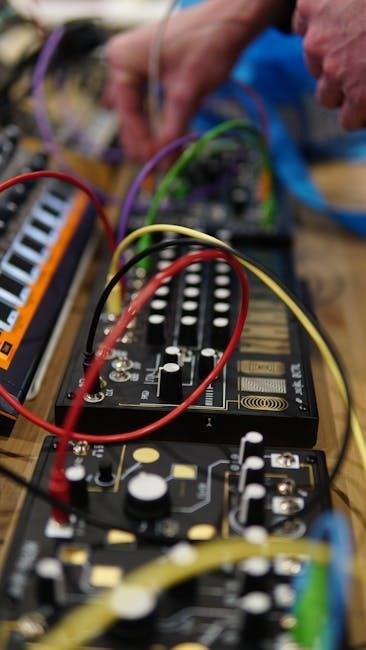
Experiment with different MMG wave shapes to drastically alter the trill’s character. Subtle adjustments to the ‘Harmonic’ control introduce rich overtones, while the ‘Frequency’ control shifts the overall tonal center. The MMG’s ability to fold and distort the signal adds a unique edge.
This combination is ideal for creating evolving drones, complex rhythmic patterns, and unpredictable textures. It’s a powerful technique for generating sounds that are both chaotic and controlled, pushing the boundaries of modulation.
Quadrature Mode: Advanced LFO Capabilities
Make Noise Maths’ ‘Quadrature Mode’ unlocks advanced Low Frequency Oscillator (LFO) capabilities, offering phase-shifted waveforms for complex modulation. This mode generates two simultaneous outputs: a standard waveform and its 90-degree phase-shifted counterpart. This is achieved by internally splitting and processing the signal path.

The primary benefit of quadrature lies in creating stereo modulation effects, where the LFO signal pans dynamically between left and right channels. This adds movement and spaciousness to sounds. It’s also invaluable for creating phasing and flanging effects when used to modulate filter cutoff frequencies or delay times.
Experimenting with different waveforms in quadrature mode – triangle, ramp, or even chaotic signals – yields diverse results. The phase difference introduces subtle or dramatic shifts in the perceived timing and texture of the modulation.
Quadrature mode is particularly effective when modulating parameters that respond to stereo signals, such as panning, chorus, or spatial effects. It allows for intricate and evolving modulation patterns beyond the scope of a standard LFO.
Voltage Controlled Transient Function Generator (A/D Envelope)
Make Noise Maths excels as a Voltage Controlled Transient Function Generator, commonly understood as an Attack/Decay (A/D) envelope. This functionality allows for dynamic shaping of audio signals or control voltages based on triggers or gates. Unlike traditional ADSR envelopes, Maths focuses on the initial attack and decay phases, offering precise control over these crucial elements.
The ‘Transient’ mode is activated by adjusting the ‘Cycle’ control and utilizing external voltage control over the ‘Time’ parameter. This allows the envelope’s duration to be modulated by other sources, creating responsive and evolving textures. The output signal rises rapidly during the attack phase, then decays exponentially towards zero.
This A/D envelope is ideal for shaping percussive sounds, creating dynamic filter sweeps, or controlling the amplitude of short, transient events. The voltage control over the decay time enables rhythmic gating and complex modulation patterns.
Experimenting with different trigger sources and modulation routings unlocks a wide range of sonic possibilities, from subtle dynamic shifts to dramatic, evolving textures. The simplicity and responsiveness of the A/D envelope make it a core component of many Maths patches.
Voltage Controlled Sustained Function Generator (A/S/R Envelope)
Make Noise Maths also functions as a Voltage Controlled Sustained Function Generator, effectively an Attack/Sustain/Release (A/S/R) envelope. This mode expands upon the A/D functionality, adding a sustained level to the envelope’s output, creating longer, evolving tones and textures. The ‘Sustain’ level is crucial for generating drones, pads, or sustained rhythmic elements.
Achieving A/S/R behavior involves careful manipulation of the ‘Cycle’ control and external voltage control over the ‘Time’ and ‘Level’ parameters. A trigger initiates the attack phase, rising to the ‘Sustain’ level. While a gate signal is present, the envelope holds at this level. Upon gate release, the envelope enters the release phase, decaying back to zero.
The voltage control over the sustain level allows for dynamic changes in the envelope’s overall amplitude, creating expressive and evolving sounds. This is particularly useful for creating evolving drones or rhythmic patterns with varying intensity.
Experimentation with different gate lengths and modulation sources unlocks a wide range of sonic possibilities, from subtle ambient textures to complex rhythmic sequences. The A/S/R mode provides a foundation for creating sustained and evolving sounds within a modular synthesis setup.

ADSR Envelope Generation
Make Noise Maths, while not a traditional ADSR envelope generator out-of-the-box, can be skillfully configured to emulate this common envelope shape. This is achieved through clever patching and utilizing the module’s versatile function generation capabilities. By combining the A/D (Attack/Decay) functionality with external control and feedback loops, a full Attack/Decay/Sustain/Release (ADSR) envelope becomes attainable.
The core of this technique involves using an external voltage source to control the ‘Sustain’ level. This can be achieved with another module, like a sequencer or LFO, modulating the ‘Level’ input. The initial Attack and Decay phases are generated using the standard A/D settings. The external voltage then introduces the sustain phase, holding the envelope at a specific level while a gate signal is active.
Finally, the Release phase is achieved by removing the gate signal, allowing the envelope to decay back to zero, governed by the ‘Decay’ time setting. This method provides a flexible and creative approach to ADSR envelope generation within the Maths module.
Experimentation with different modulation sources and patching configurations unlocks a wide range of ADSR envelope variations, offering nuanced control over dynamic shaping.
Bouncing Ball Functionality
Make Noise Maths features a unique “Bouncing Ball” mode, a creative function initially developed thanks to Pete Speer. This mode simulates a bouncing ball’s trajectory, generating a repeating, stepped envelope that’s ideal for rhythmic modulation and percussive sounds. It’s a fascinating demonstration of the module’s ability to model physical phenomena.
The bouncing ball effect is achieved by carefully balancing the ‘Rise’ and ‘Fall’ times, alongside the ‘Level’ control. The ‘Rise’ time determines how quickly the envelope rises, representing the ball’s ascent, while the ‘Fall’ time governs the descent, mimicking gravity. The ‘Level’ control sets the bounce height.
By adjusting these parameters, you can control the speed, height, and character of the bounces. This creates a dynamic and evolving signal, perfect for creating complex rhythmic patterns or modulating other parameters within your modular system. It’s a surprisingly versatile function.
Experimentation with external control voltages modulating the ‘Rise’ and ‘Fall’ times can further enhance the bouncing ball effect, adding unpredictable and organic movement to your sounds.
Independent Contours and Complex Shaping
Make Noise Maths excels in creating complex envelope shapes thanks to its ability to generate independent contours. This feature, refined with contributions from Navs, allows for separate control over the attack and decay portions of an envelope, offering a level of shaping beyond traditional ADSR generators.

Instead of a single ‘decay’ time controlling the entire return to zero, you can define a distinct contour for the decay phase. This opens up possibilities for asymmetrical envelopes, where the attack and decay have different curves and durations. Imagine a quick attack followed by a long, drawn-out decay, or vice versa.
This independence extends to voltage control; each contour can be modulated independently, allowing for dynamic and evolving envelope shapes. External control voltages can influence the timing and shape of both the attack and decay phases, creating responsive and expressive modulation.
Further complexity arises when combining these independent contours with other Maths functions, like the bouncing ball or the various LFO modes, resulting in intricate and evolving soundscapes. It’s a powerful tool for sonic exploration.
Signal Processing: Addition and Subtraction
Make Noise Maths functions as a potent signal processor, notably excelling in addition and subtraction of control voltages. This capability allows for the combination or offsetting of signals, creating new modulation sources and dynamic control possibilities within your modular system.

The core of this functionality lies in the ability to sum or difference two input voltages. Adding voltages increases the overall signal level, while subtraction creates a difference signal, effectively offsetting one voltage from another. This is incredibly useful for creating bipolar modulation signals or shifting the range of an existing control voltage.
For example, you can add an LFO to a DC voltage to create a modulated signal that oscillates around a specific point. Alternatively, subtracting one LFO from another can generate complex waveforms and phasing effects. The possibilities are vast and depend on the signals you introduce.
These operations aren’t limited to simple voltages; you can process audio signals as well, though Maths is primarily designed for control voltage manipulation. Experimentation is key to unlocking the full potential of its signal processing capabilities.
VC Portamento, LAG, and Slew Processing
Make Noise Maths offers sophisticated voltage-controlled (VC) portamento, lag, and slew processing capabilities, enabling smooth transitions and dynamic shaping of control signals. These functions are crucial for creating expressive and evolving sounds within a modular synthesis environment.
Portamento, often referred to as glide, smoothly transitions between control voltage values over a specified time. Lag introduces a delay, responding to changes in the input signal with a set time constant. Slew limits the rate of change of a signal, rounding off sharp edges and creating softer transitions.
Maths’ implementation allows for voltage control over these parameters, meaning the speed of the portamento, the lag time, or the slew rate can be modulated by other signals. This opens up possibilities for dynamic and responsive control, where the character of the transition changes over time.
These processes are invaluable for creating evolving textures, smooth filter sweeps, and expressive pitch bends. Experimenting with different modulation sources applied to these parameters will reveal a wide range of sonic possibilities.