
manual de tv hisense en español
Hisense TV Manual in Spanish: A Comprehensive Guide
Hisense television manuals in Spanish offer detailed guidance, ensuring users fully comprehend their TV’s features before initial operation, as highlighted by resources like Studocu’s guide.
Understanding the Importance of the Spanish Manual
For Spanish-speaking users, accessing a Hisense TV manual in their native language is paramount for a seamless and comprehensive user experience. These manuals transcend simple translation; they provide culturally relevant explanations of features and troubleshooting steps. Understanding the intricacies of your television becomes significantly easier when instructions aren’t lost in translation.
A Spanish manual, like the Guía de Usuario Hisense H55N5700-1 found on platforms like Studocu, emphasizes the importance of thoroughly reading the document before the first use. This proactive approach minimizes potential issues and maximizes enjoyment. It ensures users grasp all functionalities, from initial setup to advanced smart features, fostering confidence and independence in operating their Hisense TV. Ignoring this step can lead to frustration and underutilization of the device’s capabilities.
Furthermore, a Spanish manual empowers users to independently resolve common problems, reducing reliance on customer support and promoting self-sufficiency.
Where to Find the Official Hisense Spanish Manual
Locating the official Hisense Spanish manual typically begins with the Hisense website. Navigate to the “Support” or “Downloads” section, then filter by your specific TV model number. Many models offer downloadable PDFs in multiple languages, including Spanish. Resources like Studocu (hosting guides like the H55N5700-1 user guide) can also provide access, though always prioritize the official source for accuracy.
Alternatively, check the TV’s settings menu – some Hisense TVs allow you to access a digital version of the manual directly on the screen. If you’ve misplaced the physical copy that came with your TV, a quick online search using your model number and “manual en español” will yield relevant results. Be cautious of third-party websites and ensure they are reputable before downloading any files.
Hisense’s customer support can also assist in locating or providing a Spanish manual if you encounter difficulties.
Hisense TV Models with Spanish Manuals Available
Hisense offers Spanish manuals for a broad range of their television models, catering to a diverse user base. The H55N5700-1, as evidenced by resources like Studocu, is confirmed to have a readily available Spanish user guide. However, availability varies depending on the region and specific model year.
Generally, newer Hisense TV series – including A6, A7, U6, and U7 models – are more likely to include Spanish language options in their downloadable manuals. Older series may have limited or no Spanish support. Checking the Hisense support website with your exact model number is crucial for confirmation.
It’s important to note that even if a full manual isn’t available in Spanish, key sections like initial setup and troubleshooting may be translated. Always prioritize searching with the full model number to ensure accurate results.
Common Issues Addressed in the Spanish Manual
Hisense Spanish manuals comprehensively address frequently encountered problems, guiding users through solutions in their native language. These guides typically cover issues like “Sin Imagen” (No Picture) – detailing checks for cable connections, input sources, and backlight settings. Similarly, “Sin Sonido” (No Sound) troubleshooting steps are provided, focusing on volume levels, audio output configurations, and external speaker compatibility.
The manuals also dedicate sections to resolving “Problemas con el Control Remoto” (Remote Control Issues), including battery replacement, pairing procedures, and potential interference. Beyond these, common connectivity problems, software update failures, and picture quality concerns are systematically explained.
The Spanish manual aims to empower users to self-diagnose and resolve issues, reducing the need for technical support and maximizing their TV experience.
Initial Setup and Configuration (Configuración Inicial)
The Hisense Spanish manual meticulously guides users through the “Configuración Inicial” process. It begins with “Conectando a la Corriente y Conexiones Básicas” (Connecting to Power and Basic Connections), emphasizing proper power cable attachment and identifying input ports. A crucial step is “Seleccionar el Idioma” (Selecting the Language), ensuring the on-screen display and manual align for ease of understanding.
Following language selection, the manual details “Escaneo Inicial de Canales” (Initial Channel Scan). This section explains how to automatically search for available digital and analog channels, optimizing viewing options. Users are guided through selecting their region and preferred channel settings.
The manual stresses the importance of completing each step sequentially for optimal performance and a seamless initial experience.
Connecting to Power and Basic Connections
The Hisense Spanish manual’s “Conectando a la Corriente y Conexiones Básicas” section prioritizes safety and correct setup. It clearly illustrates how to securely connect the power cable to both the TV and a grounded electrical outlet, warning against using damaged cords. The manual details identifying various input ports – HDMI, USB, AV, and antenna/cable – with corresponding diagrams.
It emphasizes using high-quality cables for optimal signal transmission. Instructions are provided for connecting external devices like DVD players, gaming consoles, and sound systems. The manual also highlights the importance of properly securing all cable connections to prevent signal loss or interference.
Users are advised to consult the manual’s illustrations for accurate port identification and connection procedures.
Selecting the Language (Seleccionar el Idioma) ౼ Spanish
The Hisense Spanish manual guides users through “Seleccionar el Idioma” during the initial setup. Upon powering on, the TV presents an on-screen menu prompting language selection. The manual details navigating this menu using the remote control’s directional buttons and the ‘OK’ or ‘Enter’ key.
It specifically instructs users to locate and select “Español” from the list of available languages. The manual emphasizes that choosing the correct language ensures all on-screen displays, menu options, and help features are presented in Spanish.
Troubleshooting tips are included for scenarios where the correct language isn’t immediately visible, suggesting checking advanced settings or repeating the initial setup process. Clear screenshots illustrate each step, making the process accessible for all users.
Initial Channel Scan (Escaneo Inicial de Canales)
The Hisense Spanish manual details the “Escaneo Inicial de Canales” process, crucial for accessing local television broadcasts. After language selection, the TV prompts users to begin a channel scan. The manual explains that this process automatically searches for available over-the-air channels.
It instructs users to ensure their antenna or cable connection is properly connected before initiating the scan. The manual clarifies different scan options – ‘Auto Scan’ for a comprehensive search and ‘Network Scan’ for specific channels.
Troubleshooting advice addresses scenarios where the scan fails to detect channels, suggesting checking antenna positioning or cable connections. The manual also notes that re-scanning may be necessary after adding or removing channels, ensuring a consistently updated channel list.
Navigating the Hisense TV Menu in Spanish
The Hisense Spanish manual dedicates significant attention to menu navigation, recognizing it as fundamental for user control. It emphasizes that understanding the “Opciones del Menú Principal” is key to customizing the viewing experience. The manual details each main menu category, including ‘Picture’, ‘Sound’, ‘Channel’, ‘Network’, and ‘System’.
It explains that selecting a category reveals a sub-menu with specific settings. The manual stresses the importance of carefully reviewing each option before making changes. It provides translations for common terms, aiding Spanish-speaking users in understanding the TV’s functionalities.
Furthermore, the manual offers guidance on using the remote control to efficiently navigate the menus, highlighting the directional buttons and ‘OK’ button for selection.
Understanding the Main Menu Options (Opciones del Menú Principal)
The Hisense TV’s main menu, detailed in the Spanish manual, presents several core options. “Picture” (Imagen) allows adjustment of brightness, contrast, and color settings for optimal visual quality. “Sound” (Sonido) controls volume, equalizer settings, and audio output options. The “Channel” (Canal) menu manages channel scanning, editing, and favorite lists.
“Network” (Red) facilitates Wi-Fi connection and access to smart TV features. “System” (Sistema) handles language settings, software updates, and factory reset options. The manual emphasizes that each option contains numerous sub-menus for granular control.
It guides users through each category, explaining the function of each setting in clear Spanish terminology, ensuring a comprehensive understanding of the TV’s capabilities.
Settings Menu Explained (Menú de Configuración Explicado)
The Hisense TV’s settings menu, thoroughly explained in the Spanish manual, is logically organized into several key sections. “General” (General) encompasses system settings like language (Idioma), time, and date. “Picture” (Imagen) provides advanced controls for color temperature, sharpness, and backlight settings, influencing visual fidelity.
“Sound” (Sonido) allows customization of audio profiles, surround sound, and digital audio output. “Network” (Red) manages Wi-Fi connections, Ethernet settings, and network diagnostics. The “System” (Sistema) section handles software updates, factory reset, and energy-saving features.
The manual details each setting’s function in Spanish, offering clear explanations and guidance for optimal TV performance and user customization.
Picture Settings (Ajustes de Imagen) ౼ Spanish Terms
Within the Hisense TV’s “Ajustes de Imagen” (Picture Settings) menu, users encounter specific Spanish terminology. “Brillo” (Brightness) controls the overall light intensity, while “Contraste” (Contrast) adjusts the difference between light and dark areas. “Nitidez” (Sharpness) defines the clarity of image details.
Color adjustments include “Color” (Color), “Tono” (Hue), and “Saturación” (Saturation). Advanced settings feature “Temperatura de Color” (Color Temperature) – options like “Cálida” (Warm), “Fría” (Cool), and “Normal” (Normal). “Modo de Imagen” (Picture Mode) offers presets like “Estándar” (Standard), “Película” (Movie), and “Deportes” (Sports).
The Spanish manual clarifies each term, enabling users to fine-tune their viewing experience according to their preferences, optimizing picture quality for various content types.
Troubleshooting Common Problems (Solución de Problemas Comunes)
The Hisense Spanish manual dedicates a section to “Solución de Problemas Comunes” (Common Problems Troubleshooting), assisting users in resolving frequent issues. It guides users through diagnosing “Sin Imagen” (No Picture) scenarios, suggesting checks for cable connections and input source selection. For “Sin Sonido” (No Sound), the manual advises verifying volume levels and audio output settings.
Regarding “Problemas con el Control Remoto” (Remote Control Issues), it recommends battery replacement and ensuring a clear line of sight to the TV. The manual also addresses potential software glitches, suggesting a power cycle or factory reset as solutions.
Detailed step-by-step instructions, presented in Spanish, empower users to independently address these common problems, minimizing the need for technical support.

No Picture (Sin Imagen) ⏤ Spanish Troubleshooting
The Hisense Spanish manual’s “Sin Imagen” (No Picture) troubleshooting section begins with basic checks. Users are instructed to verify the power cable connection to both the TV and the wall outlet, ensuring a secure fit. It then prompts checking the input source selection, confirming it matches the connected device (HDMI 1, HDMI 2, etc.).
The guide advises testing with a different cable to rule out a faulty HDMI or AV cable. It also suggests trying a different device connected to the TV to isolate whether the issue lies with the TV or the source device.
Further steps include adjusting the brightness and contrast settings, and if those fail, a power cycle of the TV is recommended. The manual emphasizes consulting a technician if the problem persists.
No Sound (Sin Sonido) ⏤ Spanish Troubleshooting
The Hisense Spanish manual’s “Sin Sonido” (No Sound) section guides users through a series of checks. Initially, it instructs verifying the volume level on both the TV and any connected external devices, like a soundbar or receiver. It emphasizes ensuring the TV isn’t muted – a common oversight.
The manual then directs users to check the audio output settings, confirming the correct output source is selected (TV speakers, Optical, HDMI ARC, etc.). It suggests testing different audio sources, such as switching between built-in apps and external devices, to pinpoint the issue.
Further troubleshooting involves checking the connections of external audio devices and attempting a power cycle of both the TV and the audio system. If the problem remains, the manual recommends contacting technical support.
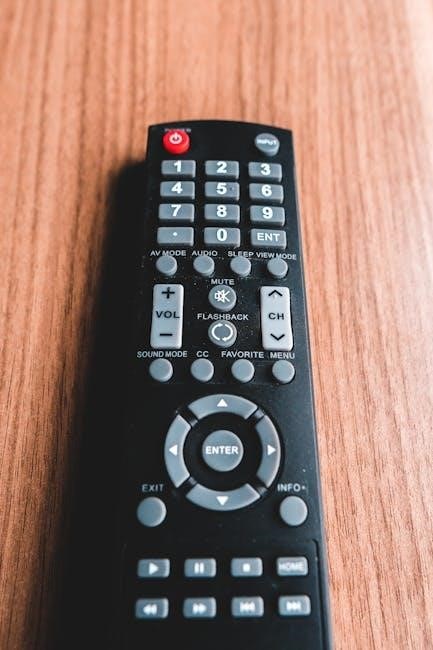
Remote Control Issues (Problemas con el Control Remoto)
The Hisense Spanish manual addresses “Problemas con el Control Remoto” (Remote Control Issues) with a systematic approach. The first step involves checking the batteries, recommending replacement with fresh ones to rule out a power deficiency. It advises ensuring there’s a clear line of sight between the remote and the TV’s infrared sensor, removing any obstructions.
The manual then guides users through a remote pairing or reset procedure, often involving a specific button combination. It suggests cleaning the remote’s infrared emitter and the TV’s sensor with a soft cloth. If the remote still malfunctions, the manual recommends trying the TV’s physical buttons for basic control.
Finally, it suggests consulting the support section of the Hisense website or contacting customer service for further assistance or a potential remote replacement.
Using Smart TV Features in Spanish
The Hisense Spanish manual dedicates a section to navigating the Smart TV functionalities, explaining features like “Acceder a Aplicaciones de Streaming” (Accessing Streaming Apps). It details how to locate and launch pre-installed apps such as Netflix, YouTube, and Prime Video directly from the home screen. Users are guided through the process of downloading additional apps from the Hisense app store, often requiring a Hisense account login.
The manual also provides instructions on customizing the home screen, organizing apps, and utilizing voice control features if available. It explains how to manage app permissions and update software to ensure optimal performance. Furthermore, it covers the integration of mobile devices for screen mirroring and content sharing;
The guide emphasizes the importance of a stable internet connection for seamless streaming and app functionality.
Accessing Streaming Apps (Acceder a Aplicaciones de Streaming)
The Hisense TV’s Spanish manual thoroughly explains how to access streaming applications, beginning with navigating to the “Apps” section on the home screen. It details that pre-installed apps, like Netflix, YouTube, and Amazon Prime Video, are readily available. Users are guided through the selection process, using the remote control to highlight and launch their desired service.
For apps not pre-installed, the manual instructs users to open the Hisense app store – often labeled as “Content” or “Apps” – and search for the specific streaming service. It clarifies the need for a Hisense account or a compatible login to download and install these applications.
The guide also covers managing app subscriptions and updating apps for optimal performance, ensuring a smooth streaming experience.
Connecting to Wi-Fi (Conectarse a Wi-Fi) ౼ Spanish Instructions
The Hisense TV’s Spanish manual provides clear, step-by-step instructions for connecting to a Wi-Fi network. It begins by directing users to the “Settings” menu, then to the “Network” or “Wi-Fi” section. The manual emphasizes the importance of selecting the correct network from the list of available options.
When prompted, users are guided to enter their Wi-Fi password using the on-screen keyboard, paying close attention to capitalization and special characters. The manual details troubleshooting steps for connection failures, such as verifying the password or restarting the router.
It also explains how to switch between different Wi-Fi networks and how to configure a static IP address for advanced users, ensuring a stable and secure internet connection for streaming and smart TV features.